Critical Illness Insurance in Milton, Ontario
Critical illness insurance pays you a lump sum if you are diagnosed with one of the conditions your policy covers and you survive a waiting period written into the contract. The money is yours to use for anything. This page explains what that is actually for in Ontario, where most treatment is already covered by OHIP, and what decides whether the coverage is worth carrying.
I am Dean Kulla, a Financial Advisor, Owner of Kulla Financial in Milton. I am licensed in Ontario for life and accident and sickness insurance, and I am a mutual fund dealing representative with Sterling Mutuals Inc.
What critical illness insurance is for in Ontario
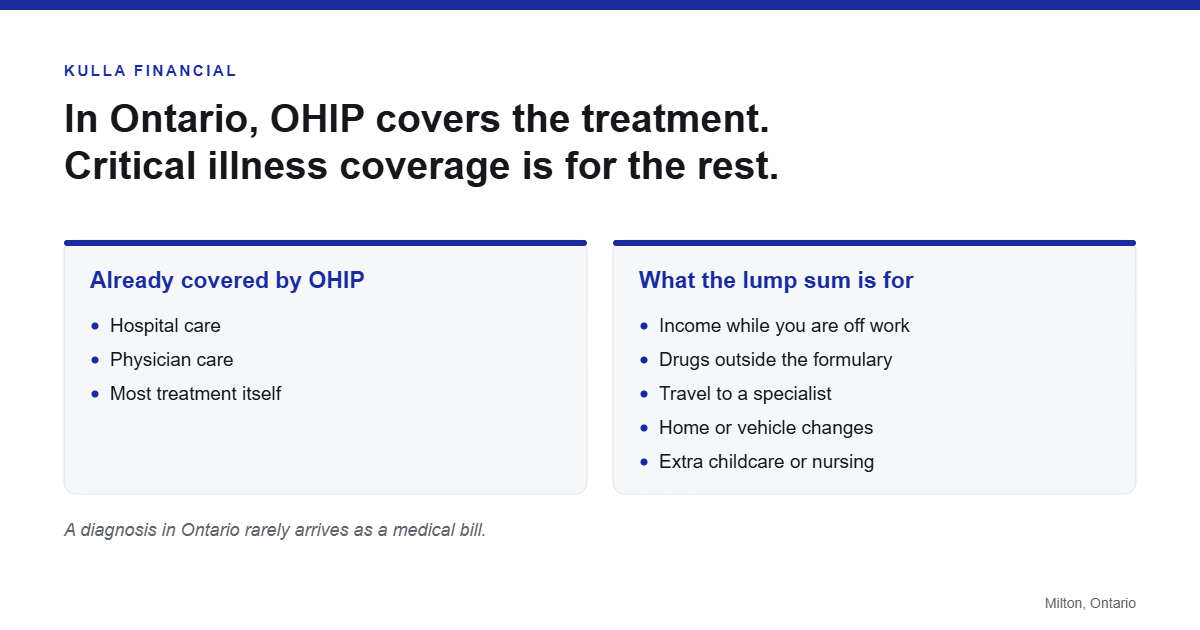
It is not there to pay your hospital bill. OHIP covers most of the treatment itself, which is the single biggest difference between how this product works in Canada and how it is described on most websites.
What it covers is everything around the treatment. The income you stop earning while you are off work. The income your spouse stops earning if they take time off to care for you. Prescription drugs that are not on the provincial formulary. Travel and accommodation if the specialist you need is in Toronto or further. Home or vehicle modifications. Private nursing or extra childcare. Debt that keeps accruing while your household income drops.
Essentially, a diagnosis rarely arrives as a medical bill in Ontario. It arrives as a hole in your household income at the exact moment your expenses go up.
How the policy decides whether to pay
Three things in the contract decide it, and they matter far more than the coverage amount.
The condition list. Every policy names the conditions it covers and defines each one in medical language. Two policies can both say they cover cancer and define it differently. The definition in your contract is what governs, not the name of the illness.
The survival period. You have to survive a set number of days after diagnosis before the benefit is payable. This is standard and it is written into the policy.
The exclusions and the pre-existing condition terms. These are set when the policy is issued, based on what you disclosed on the application.
This is why reading the contract matters more here than on almost any other product. Whether a particular diagnosis triggers a payment is decided by the wording in your policy, and neither I nor anyone else can tell you in advance that a future claim will be paid.
Critical illness or disability insurance?
They answer different questions and a lot of people buy one thinking they bought the other.
| Critical illness | Disability | |
|---|---|---|
| What triggers it | A diagnosis on the policy’s list, plus surviving the waiting period | Being unable to work, as your policy defines that |
| How it pays | One lump sum | A monthly benefit while you remain disabled |
| If you recover and return to work | You keep the money | Payments stop |
| If you are off work but not diagnosed with a listed condition | Nothing is payable | May pay, depending on the definition |
Most households that can only carry one are better served by getting the disability question right first, because being unable to work is the more common event. That is a general observation, not advice about your situation. See disability insurance.
What this looks like in Milton
Milton’s household profile is the one where a diagnosis does the most financial damage.
At the 2021 Census the town had 132,979 residents, an average age of 35.2, and had grown 20.7% since 2016. Median household income was $126,000 for 2020. (Source: Statistics Canada, 2021 Census Profile, Milton.)
A median household income at that level in a town that grew that fast usually means two earners and a recent mortgage. A household like that does not have a spare income to lose, and it does not have twenty years of savings behind it yet. That is the gap this product is built for.
What most people get wrong
Assuming it pays medical bills. It does not, and in Ontario it does not need to. It replaces income and covers the costs OHIP leaves behind.
Buying on the condition count. A policy covering twenty-five conditions is not automatically better than one covering four. The definitions decide claims, not the length of the list.
Assuming the coverage at work does the same job. Group critical illness coverage, where it exists at all, is usually a small flat amount and it ends when the job ends.
Leaving it until after a diagnosis is on file. Health history is assessed when you apply. Anything already in your records is part of that assessment.
Whether an insurer offers you coverage, and on what terms, is the insurer’s decision after it reviews your application and your medical history. Nobody can promise you an outcome there.
Questions people ask
What happens if I never claim?
On most policies, nothing comes back. Some contracts include a return of premium option at an added cost. Whether that option is worth it depends on your situation and the policy, and it is a specific thing to ask about rather than assume.
Is the benefit taxable?
A critical illness benefit paid to an individual on a personally owned policy is generally received tax free. How that applies to you depends on who owns the policy and who pays the premiums, which is worth confirming rather than assuming.
Can I get it if I have had cancer before?
Possibly, and possibly not, and it depends on the insurer and on the details. It is a question to put to an underwriter rather than to rule yourself out in advance. See coverage when you have been rated or declined.
Can I add it to a life insurance policy instead?
Often yes, as a rider. A rider and a standalone policy behave differently on claim and on renewal, so the choice is worth making deliberately. See life insurance.
Does it cover mental health conditions?
Generally not. Most contracts cover a defined list of physical conditions. If income protection during a mental health absence is the concern, that is a disability insurance question.
What to do next
Book a fact-finding appointment. We go through what your household would actually lose in the first year after a diagnosis, and whether this product or disability coverage is the one that closes that gap.
Book an appointment with Dean Kulla
If you would rather talk first, call 905-636-4401 or email dean.kulla@kullafinancial.com.
This page is general information, not advice. It does not consider your situation, and your situation is the part that decides the answer. Whether a claim is payable is determined by the wording of your own policy. Dean Kulla is a Financial Advisor with Kulla Financial, licensed in Ontario for life and accident and sickness insurance, and a mutual fund dealing representative with Sterling Mutuals Inc. Insurance products are provided independently by Dean Kulla and are not the business of Sterling Mutuals Inc.
Rules and program details change. Check the source links before relying on anything here. Last updated 14 September 2026.