Mortgage Protection Insurance in Milton, Ontario
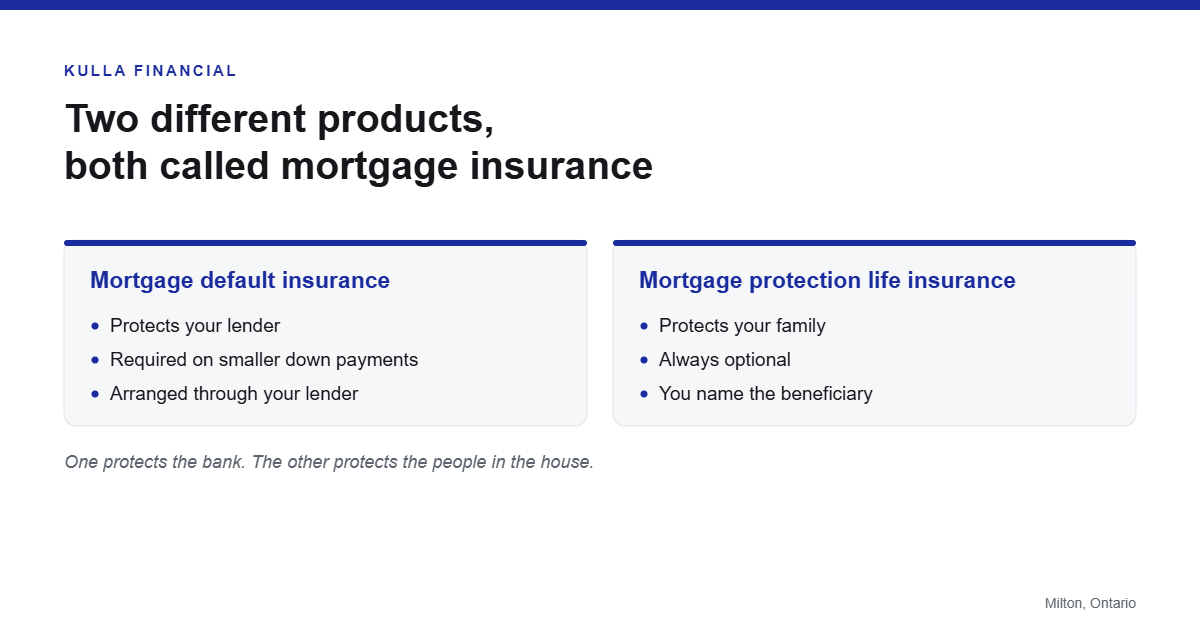
Mortgage insurance in Milton means one of two completely different things, and people confuse them constantly. One protects your lender if you stop paying. The other is life insurance sized to clear your mortgage if you die, so your family keeps the house without the payments. This page separates them, then explains the real choice you have.
I am Dean Kulla, a Financial Advisor with Kulla Financial in Milton. I am licensed in Ontario for life and accident and sickness insurance, and I am a mutual fund dealing representative with Sterling Mutuals Inc.
The two products people confuse
They protect different people. One protects the bank and one protects your family.
| Mortgage default insurance | Mortgage protection life insurance | |
|---|---|---|
| Who it protects | The lender, if you stop paying | Your family, if you die |
| When you need it | Required when your down payment is under 20% of the purchase price | Never required. It is your decision |
| Who provides it | CMHC, Sagen or Canada Guaranty, arranged through your lender | A life insurer, through your lender or through an advisor |
| Do I sell it | No. It is arranged by your lender, not by me | Yes |
CMHC puts it plainly: “If you want to buy a home with a down payment of less than 20%, you’ll need mortgage loan insurance,” and “this protects your lender in case you can’t make your payments.” (Source: CMHC, what is mortgage loan insurance.)
So if you were told you must buy mortgage insurance to get approved, that was default insurance, and it is not what this page is about.
The second product is different in one important way: it is optional. The Financial Consumer Agency of Canada states it directly. “This product is optional. You don’t need to purchase optional mortgage insurance to be approved for a mortgage.” (Source: FCAC, optional mortgage insurance products.)
Everything below is about the second column.
Two ways to cover a mortgage with life insurance
You can take the coverage your lender offers at the signing table, or you can own a policy yourself. Both are legitimate and they behave differently. Neither is the right answer for everybody.
| Lender-offered creditor coverage | A policy you own | |
|---|---|---|
| Who owns it | The coverage is arranged by the lender under a group contract | You do |
| Who receives the money | The lender. FCAC: “The mortgage lender is the beneficiary of any mortgage life insurance policy” | The beneficiary you name, who decides what to do with it |
| Coverage amount over time | Declines. FCAC: “The death benefit decreases as you make mortgage payments and reduce your outstanding balance” | Stays at the amount you chose for the term you chose |
| If you switch lenders | Generally ends with that mortgage | Unaffected. It moves with you |
| When health is assessed | Usually a short set of questions at the signing table. Ask when eligibility is actually determined and what the pre-existing condition terms are | Underwritten when you apply, so you know at the outset whether you are covered |
| Setting it up | A few questions at the signing table | An application and usually medical underwriting, which takes weeks |
(Source for the creditor coverage column: FCAC, optional mortgage insurance products.)
The honest summary is that lender coverage is convenient and a personally owned policy gives you control over the amount, the beneficiary and the portability. Which of those matters more depends on your situation, and there are households where the convenience genuinely wins, particularly where health history makes personal underwriting difficult.
Why the beneficiary question is the one worth thinking about
With lender coverage the lender is the beneficiary, so the money clears the mortgage. That sounds like the same thing as giving it to your family, and it usually is not.
Your family might rather keep the mortgage and use the money for something more urgent. They might want to sell and move closer to relatives. They might have childcare costs that matter more this year than a paid-off house. When you own the policy and name a person, they get to make that call. When the coverage is applied to the balance, the decision is already made.
Essentially, clearing the mortgage is one possible use of the money, and your family may not choose it.
What mortgage insurance looks like in Milton
Milton is a town of recent mortgages, which is exactly the population the mortgage insurance question applies to.
At the 2021 Census the town had 132,979 residents, an average age of 35.2, and had grown 20.7% since 2016. Median household income was $126,000 for 2020. (Source: Statistics Canada, 2021 Census Profile, Milton.)
A town that grew a fifth in five years is a town where a large share of households signed a mortgage recently, and where the lender’s coverage was offered across the desk at the same appointment. If that is when you decided, it is worth revisiting with more than five minutes to think about it.
What most people get wrong
Thinking this is a separate product from life insurance. Mortgage protection is life insurance doing one specific job. Which means the sensible question is not “do I need mortgage insurance” but “how much life insurance do I need in total, and is the mortgage the whole of it.”
Insuring only the mortgage. The mortgage is one line in what a household loses. There is also the income, the childcare, and the years to get children to independence. See how to work out the total coverage amount.
Buying it twice. Plenty of people carry lender coverage and a personal policy and a group life benefit at work, all partly covering the same thing. Adding them up is a fifteen minute exercise.
Never reading the certificate. Creditor coverage comes with a certificate of insurance setting out the exclusions and the pre-existing condition terms. It is the document that decides what you actually bought, and it is worth reading before you decide rather than after a claim.
Whether an insurer offers you coverage, and on what terms, is the insurer’s decision after it reviews your application and your medical history.
Questions people ask
I already took the coverage from my bank. Should I cancel it?
Not before something else is in force. The order matters: get the replacement approved and issued first, then decide about the existing coverage. Cancelling first can leave you with a gap and no way to close it if underwriting goes badly.
Is term life insurance the right type for a mortgage?
It is the type most commonly used, because a mortgage is a defined obligation over a defined period and term coverage matches that shape. Whether it is right for you depends on what else you are covering.
Should the coverage decline as the mortgage does?
That is a real choice. A declining amount matches the debt. A level amount leaves your family something beyond the house. Neither is automatically correct.
What about critical illness or disability coverage on the mortgage?
Those cover different events, and being off work is more common than dying. See critical illness insurance and disability insurance.
My partner and I both work. Do we both need coverage?
If losing either income would make the payments unmanageable, then both incomes are carrying the mortgage and both are worth looking at.
What to do next
Book a fact-finding appointment. We add up what you already have, including anything from your lender and your employer, and work out what is actually left uncovered.
Book an appointment with Dean Kulla
If you would rather talk first, call 905-636-4401 or email dean.kulla@kullafinancial.com.
This page is general information, not advice. It does not consider your situation, and your situation is the part that decides the answer. Whether a claim is payable is determined by the wording of your own policy. Mortgage default insurance is arranged through your lender and is not a product offered by Kulla Financial. Dean Kulla is a Financial Advisor with Kulla Financial, licensed in Ontario for life and accident and sickness insurance, and a mutual fund dealing representative with Sterling Mutuals Inc. Insurance products are provided independently by Dean Kulla and are not the business of Sterling Mutuals Inc.
Rules and program details change. Check the source links before relying on anything here. Last updated 14 September 2026.